Signs a Tree Near Your House Needs to Come Down
Most trees that fail near a house gave warning first; here is what to look for and what it usually means.
October 7, 2026 · 4 min read
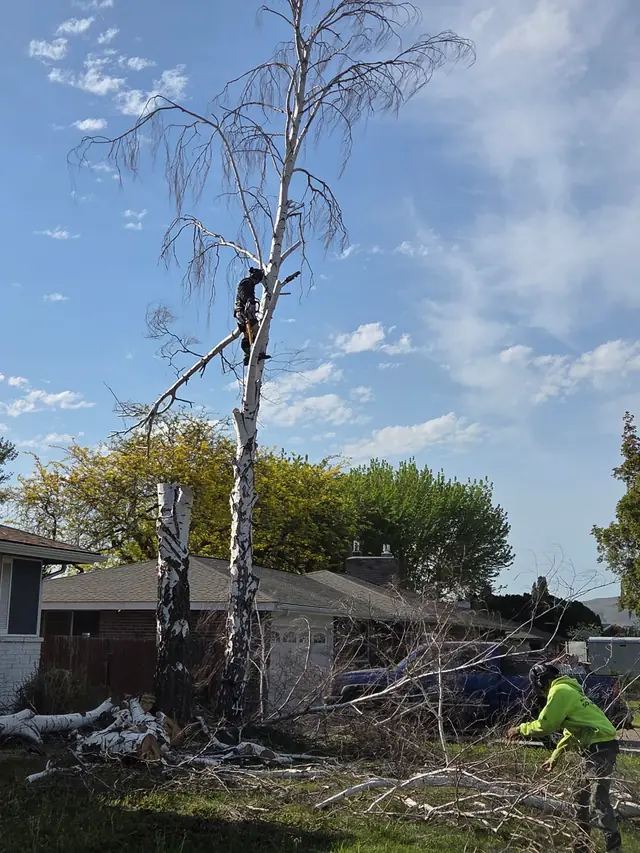
Most trees that fail near a house gave plenty of warning. The trouble is that the signs are easy to walk past: a crack you've seen for years, a mushroom you took for a lawn problem, a dead top you figured was just the season. Here's what to look at, and what it usually means.
Split forks and cracks
Look at where the trunk divides into two or more main stems. If the fork is a tight V with bark pinched into the crotch, the two stems are not truly joined, and as they thicken they push each other apart. A crack running down through that fork, or one stem visibly sagging away from the other, is serious. A long vertical crack in the trunk itself deserves the same attention. These trees can hold for years and then let go in the first hard wind or heavy snow.
Dead tops and bare limbs
A tree that's leafless in the upper crown in July while the lower branches are green is telling you something. So is an evergreen whose top has gone brown and brittle. Dead wood is dry and loses strength, and dead limbs over a roof, a driveway or a play area can fall without warning. A handful of dead twigs is normal. Dead limbs as thick as your wrist, especially several of them, are a reason to call.
A lean, and what the ground says
A lean that's been there since the tree was young is usually the tree compensating, and it can be stable. A lean that's new, or getting worse, is different. Look at the soil around the base. A raised mound on one side, fresh cracks in the dirt or lawn, or roots lifting out of the ground mean the root plate is moving. Trees that have had trenching, new paving or construction near their roots can fail years afterward, because roots that anchored them were cut.
Fungus and decay at the base
Mushrooms or shelf-shaped growths on the trunk, at the base or on exposed roots usually mean wood is rotting inside. Other clues are a hollow sound when you knock on the trunk, soft crumbly wood, or a cavity you can see into. Decay doesn't mean a tree is about to fall tomorrow, since a tree can carry a lot of rot and still stand. But the strength is gone from the places that matter most, and it's hard to judge how much is left from the lawn.
A short list to walk the yard with:
- A V-shaped fork with bark squeezed between the stems, or a crack through it.
- A dead top, or several dead limbs thicker than your wrist.
- A lean that's new, or soil heaved up on one side of the base.
- Mushrooms, shelf growths or soft wood at the base or on the roots.
- Large limbs hanging in the crown after a storm, even if they're still attached.
- Roots that were cut or buried by recent digging or paving.
Why a big tree comes down in sections
People picture a tree being felled in one cut and one big fall. That works in an open field. Next to a house, a fence, a shed or a power line there isn't room for it, and a tree that's already weak can move unpredictably when it's cut. So large trees near structures come down in pieces. A climber ties in with ropes, or the crew works from a bucket truck, and the work goes from the top down. Each limb or section is cut, held on a rigging line and lowered to the ground under control, with a groundsman managing the rope and everyone else kept clear.
Philip Edinger had a very tall pine handled this way, and his Google review puts it plainly: “They took down a 100’+ pine tree all of the way to the ground and worked their tails off!” That's the idea behind sectional removal. The tree gets smaller on the way down, so nothing big ever has to fall.
After a storm, and getting someone to look
After wind or heavy snow, look up before you clean up. A broken limb hanging in the crown, caught on other branches, can drop at any time, and it's dangerous to stand under or to try to pull down yourself. Stay out from under it, keep kids and pets away, and take photos from a safe distance. West Valley Tree Service does storm damage cleanup and hazardous removal, and its website says it's always available after hours, so a call or text at night is fine.
Not every worrying tree needs to come down. Some need the dead wood taken out, some need a careful prune, and plenty need nothing at all. That call is made standing next to the tree, which is why Carlos looks before he quotes anything. Text a photo to (509) 961-5496 to start, or just call. The estimate is free, and finding out a tree is fine is a good thing to learn.
West Valley Tree Service LLC, (509) 961-5496
Call (509) 961-5496More articles
Natural-Look Pruning vs. Topping: What Your Tree Needs
A tree cut back to stubs looks tidy for a season and costs you for a decade; here is the cut that keeps it healthy.
What Happens After Stump Grinding: Chips, Settling, Replanting
The grinder is the short part of the job; the next two years of the spot are what most people never get told about.