West Valley Tree Service · Yakima
Tree trimming and pruning in Yakima that leaves old trees looking natural
Thinning, raising and shaping cuts made at the branch collar, planned for this season and for the growth that follows, so the tree reads as itself and not as a stub.
Chapter 01
Topped crowns, lion-tailed limbs and the regrowth that follows
A hard-cut tree is easy to spot from the street. The crown is sheared flat, the inner branches are stripped out and tufts are left only at the tips of the limbs. That is lion-tailing. Topping, which lops the leader and every main limb back to stubs, gives the same lopsided result.
The tree answers a heavy cut with a crop of fast, weakly attached shoots from the stubs, which are thick enough to look like recovery and soft enough to break in the next windstorm. Old trees, which have less stored energy to spend, take the cut hardest. The wound is also where rot gets in, and it can take years to show.
So before the first cut, we read the tree: where the crown is heavy, where the branches cross and rub, what is dead, what is shading the roof and what is simply in the way. Then we decide how much it can lose this year. Often that is less than the owner expected, and the rest can wait for a second visit.
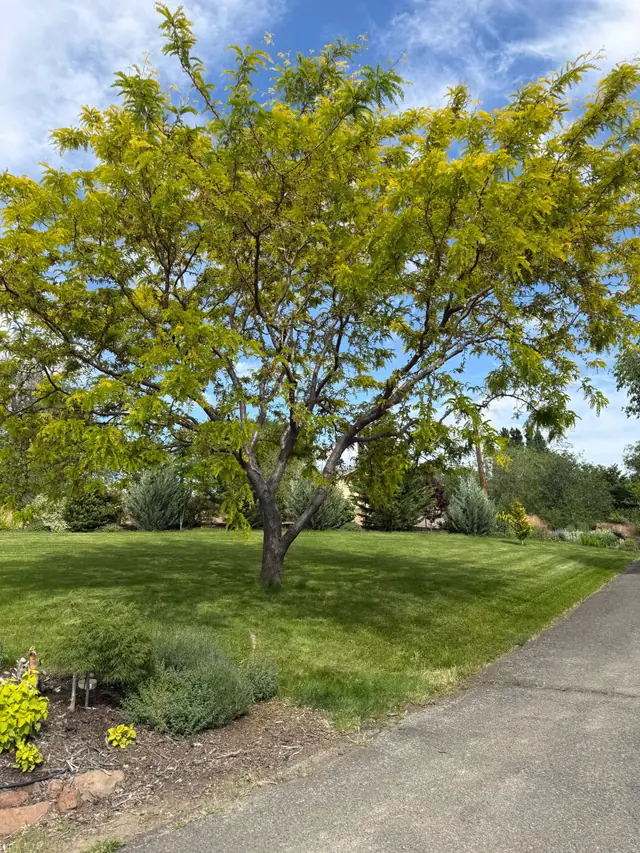
A shade tree with an even, open crown after pruning, standing on a landscaped lawn
Thin from the inside, raise from below, cut back to the collar
Thinning takes out whole branches from inside the crown, back to where they come off a larger limb, so light and air move through and the outline stays as it was. Raising takes off the lowest limbs to clear a walk, a drive or a roofline. Both are about choosing which branches go, not about reducing the height.
Each cut goes back to the branch collar, the slightly swollen ring where a branch meets its parent. A cut made there closes over cleanly. A stub left beyond it rots, and a cut flush against the trunk takes the collar with it. This is the small, repeated detail that separates a natural-look prune from a hack job.
Reed Ball, who had Carlos trim trees of advanced age at his place, wrote that each one came out looking completely natural, sculpted for the present and with future growth in mind. That is the standard for one shade tree or a whole row of ornamentals.
Chapter 03
Fruit trees in the dormant season, and when to call us back
In orchard country the pruning calendar matters. Apple, pear, cherry and other fruit trees are generally pruned while they are dormant, in late winter before the buds swell. Many ornamentals can be shaped in the same window, and anything dead or hazardous can come out any time of year. Ask when we look at the tree and we will say which cuts should wait and which should not.
Brush from the cuts goes on the dump trailer, and the lawn and beds are raked before the crew leaves. Nick Blumenthal said the trees turned out looking so much healthier after their trim, and that the crew was on time and kept him informed about arrivals and departures.
We trim in Yakima, the West Valley, Union Gap, Selah, Naches, Toppenish, Wapato and the surrounding areas. The estimate is free: call or text (509) 961-5496, tell us how old the tree is and what is bothering you about it, and we will look at it before agreeing on any cuts.
Nick Blumenthal, Google review: “Everyone was on time, great communication about arrivals/departures and the trees turned out looking so much healthier after their trim.” Rated 5.0 from 38 Google reviews. Call (509) 961-5496.