West Valley Tree Service · Yakima
Hazardous tree removal and storm damage clean-up in Yakima and the West Valley
Split, leaning and dead trees over roofs, fences and lines, and the limbs a storm leaves hanging. Read from the ground first, then rigged down piece by piece instead of dropped.
Chapter 01
Where a failing tree gives itself away
A tree that is about to hurt something usually shows it first. Two stems that have split apart where they join. A dead top that no longer leafs out. A lean that is worse than it was last summer. A limb snapped in a windstorm that is still hung up in the crown, waiting for the next gust. Each one matters most when there is a roof, a fence, a car or a power line underneath.
Wood that is split or dead does not hold the way sound wood does, and a limb under tension can swing or kick the moment it is cut. That is why the first job on a hazardous tree is reading it, from the ground, before anyone ties in: where the weight sits, what is loaded and what is slack, what is parked or planted below, and where a person can stand safely while the work happens.
Carlos looks at the tree in person before anything is quoted. If you can, text a photo of it to (509) 961-5496 first and say what it is leaning toward. It saves a trip on the ones that are clearly fine and moves the urgent ones up the list.
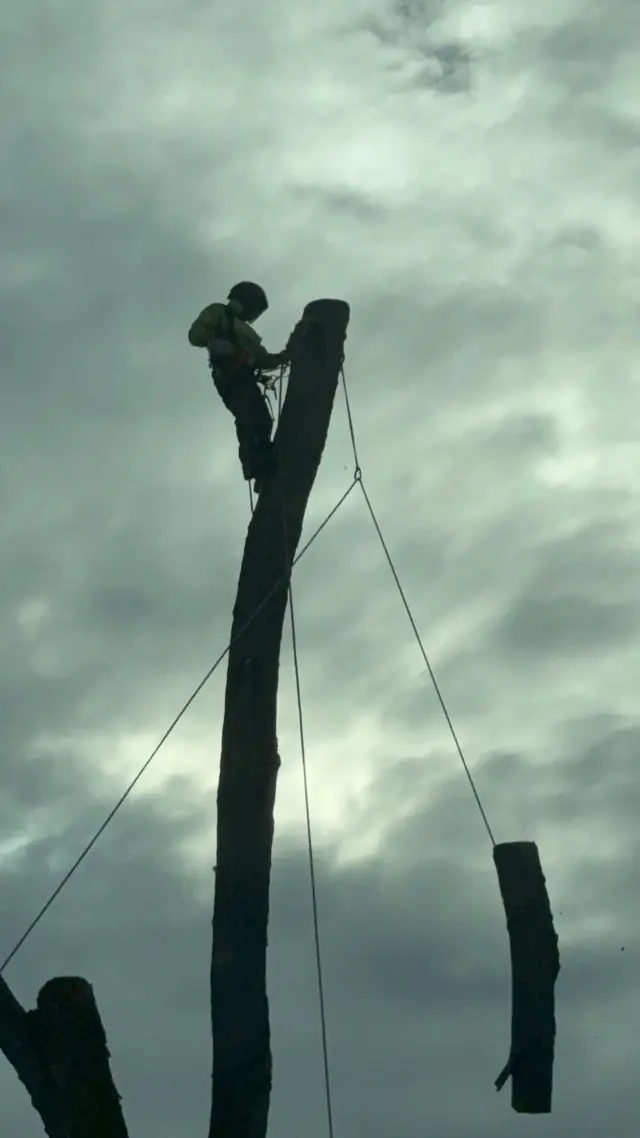
A climber silhouetted on top of a tall spar with rigging lines, a log section being lowered
Taken apart from the top, lowered on a line
Over a house or beside a fence there is no room to fell a tree whole, so it does not come down whole. A climber tied in high, or a crew member in the bucket truck, takes the tree apart from the top, one section at a time. Each piece is tied off to a rigging line, cut free and lowered to the ground under control. The photo above shows exactly that moment: a log section hanging on a line below a climber at the top of a spar.
On the ground, the rest of the crew keeps people and vehicles out of the drop zone and handles the line. Pieces are lowered, not thrown, and the heavy wood comes down slowly enough that it does not gouge a lawn or take out the fence it was cleared to protect.
Some of these trees can be reached by bucket and some only by climbing, and the call is made on site. The aim is the same either way: the tree comes out in sections, and nothing it is standing over takes the hit.
Chapter 03
After the storm: photographs, brush and a raked yard
After a storm, the damage is rarely one clean break. It is a snapped top, a half-split trunk, limbs across the drive and brush spread across half a yard. Before anything is moved, take photographs of the damage from a few steps back and up close, with the date, in case you need them for your own insurance claim. That is general guidance; what an insurer covers is between you and your insurer.
Then the clean-up. Limbs are cut up, the wood and brush are loaded and hauled, and the ground is raked. One customer wrote that the crew took down a 100 foot pine all of the way to the ground and totally cleaned up the work area after. Another said that once they were finished it was like they were never there.
West Valley Tree Service covers Yakima, West Valley, Union Gap, Selah, Naches, Toppenish and Wapato. Estimates are free, veterans receive 10% off, and the crew is always available after hours: call or text (509) 961-5496, day or night, when something has come down or is about to.
“They took down a 100’+ pine tree all of the way to the ground and worked their tails off!” Philip Edinger, Google review. West Valley Tree Service is rated 5.0 from 38 Google reviews.